 SidebySpeak
 Blog
Simultaneous Interpretation: What It Is and How It Works
Simultaneous interpretation is spoken translation delivered in real time. An interpreter listens to a speaker in one language and says the message aloud in another language a few seconds behind, witho...
Simultaneous interpretation is spoken translation delivered in real time. An interpreter listens to a speaker in one language and says the message aloud in another language a few seconds behind, without waiting for the speaker to stop. Listeners hear the result through headphones or a quiet whisper while the speech continues. It is the standard mode at the United Nations and at European Union institutions.
Consecutive interpretation works differently. The speaker pauses, and the interpreter speaks afterward. That one difference changes the equipment, the staffing, the cost and the pace of an event.
This article covers why simultaneous interpretation matters, how it works step by step, how it compares with consecutive, which types and examples you will meet, and how people learn to do it. We build live translation software at SidebySpeak, so we also explain where machine captions fit and where a human interpreter is still the right choice.
Why simultaneous interpretation matters
Simultaneous interpretation matters because it lets people who speak different languages take part in one event at the speed of the original speaker. Nobody waits for a second delivery, and the discussion keeps its rhythm.
Benefits for speakers and audiences
The biggest gain is time. In consecutive mode every statement is spoken twice, so a session can run close to twice as long. With simultaneous interpretation, a one-hour panel stays a one-hour panel. The other benefits follow from that:
- Natural flow. Speakers keep their pacing, humor and emphasis, and listeners react at the same moment as everyone else.
- Many languages at once. Each language gets its own audio channel, so one speech reaches several language groups together.
- Scale. Hundreds of people can listen through headsets or an app without any break in the program.
Simultaneous interpretation matters because the event runs at the speed of the speaker, not at half that speed.
Where it is used
You will meet it at the United Nations, in the European Parliament (24 official languages), at international conferences, in board meetings with foreign investors and in multilingual webinars. It became standard after the Nuremberg trials of 1945 and 1946, where interpreters worked through headset equipment to keep a multilingual trial moving.
What it costs
Cost is the trade-off. Rates vary with the language pair, the interpreters' experience, the event length and your region, and most professionals quote by the half day or full day. Plan for at least two interpreters per language, plus booth and headset rental for on-site events. If you are an interpreter setting your own rate, the same factors apply. Get written quotes instead of relying on an average, and send slides and glossaries ahead of time, because preparation drives quality.
How simultaneous interpretation works in real time
Simultaneous interpretation works by running three tasks at once: listening to the speaker, restructuring the meaning into the target language, and speaking the result. The interpreter does all three continuously, with a delay of a few seconds.
The listen, process, speak cycle
That delay is called the ear-voice span, or décalage. Say a speaker states in Spanish: "Nuestras ventas crecieron un doce por ciento en el tercer trimestre, gracias a la nueva línea de productos." The interpreter hears "Nuestras ventas crecieron" and holds that thought. Then they start in English: "Our sales grew twelve percent in the third quarter..." while already listening for what comes next.
A short lag gives the interpreter enough context to choose the right words. A long lag risks losing the next sentence. Word order makes this harder. In German, the verb often arrives at the end of a clause, so the interpreter must wait, predict or restructure.
Booths, teams and equipment
On site, interpreters sit in a soundproof booth with a console, a microphone and headphones, and they see the speaker and the slides. Listeners wear receivers and pick a language channel. For small groups, a portable transmitter system replaces the booth.
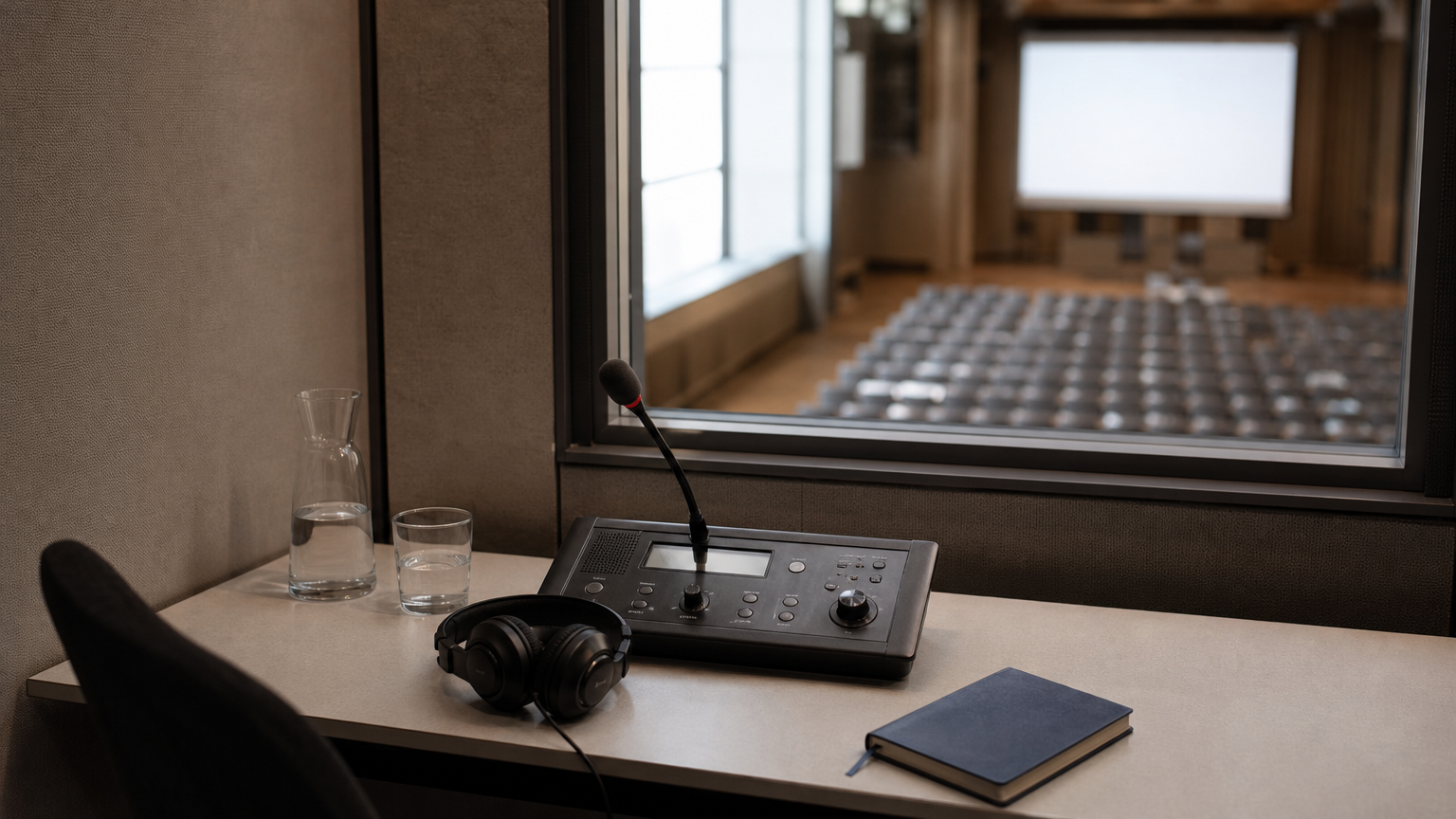
Staffing matters as much as hardware. Interpreters work in pairs and swap about every 20 to 30 minutes, because accuracy drops as fatigue builds. When no interpreter speaks both the speaker's language and the audience's language, relay interpreting uses a third language as a bridge.
Why it is so difficult
The task is hard because the brain splits attention between input and output under constant time pressure. Numbers, names, accents, jargon and jokes arrive with no pause to check them. Interpreters cut the strain with advance research, shared glossaries and the speaker's script when one exists.
The core skill is not vocabulary but managing attention: listen, think and speak at once without falling behind.
Simultaneous vs consecutive interpretation
The main difference between consecutive and simultaneous interpretation is timing. In consecutive mode the interpreter speaks after the speaker pauses. In simultaneous mode the interpreter speaks while the speaker is still talking.
Side-by-side comparison
| Feature | Simultaneous | Consecutive |
|---|---|---|
| Timing | A few seconds behind the speaker | After the speaker pauses |
| Event length | About the same as the original | Much longer, since everything is said twice |
| Equipment | Booth and headsets, or a whisper | Usually none, only a notebook |
| Interpreters | Two per language, swapping | Often one for short sessions |
| Best for | Conferences, large audiences, live broadcasts | Interviews, negotiations, small meetings, site visits |
| Strength | Flow and speed | Precision and time to check wording |
| Note-taking | Minimal | A core skill |
How to choose
Pick simultaneous interpretation when the audience is large, the program is tight or several languages are needed at once. Pick consecutive when the group is small, the talk is a conversation with back and forth, or exact wording matters, as in a contract discussion. Many events use both: simultaneous for the keynote, consecutive for the Q&A table.
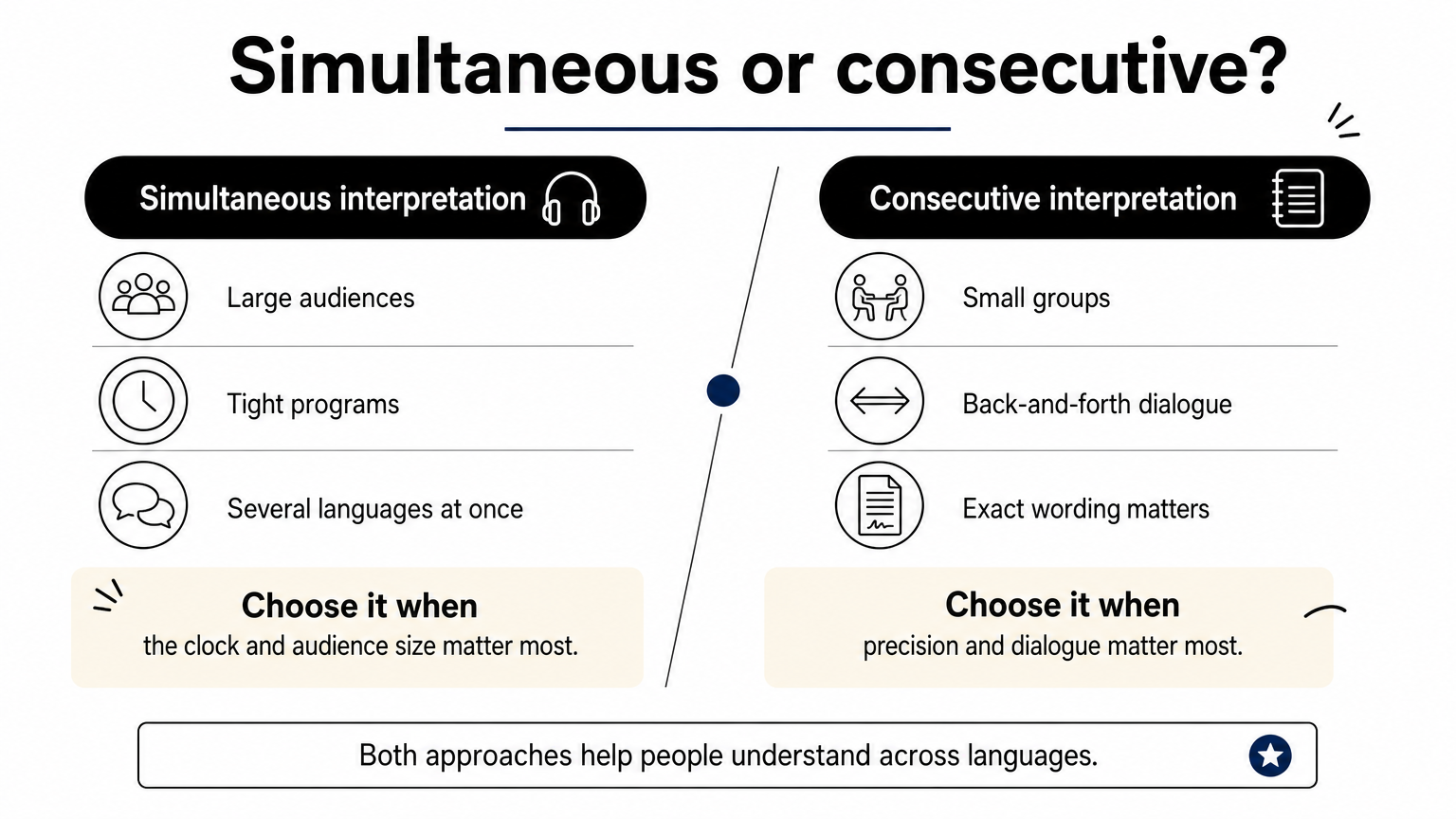
If the clock and the audience size matter most, choose simultaneous. If precision and dialogue matter most, choose consecutive.
Types and examples of simultaneous interpretation
There are four common types of simultaneous interpretation, and each suits a different setting. The mode is the same in all of them: the interpreter speaks while the original speech continues.
The main types
- Conference interpretation: interpreters work in a booth and listeners use headsets. This is the classic format.
- Whispered interpretation (chuchotage): the interpreter sits beside one or two listeners and whispers. It needs no equipment but suits only very small groups.
- Remote interpretation: interpreters work from another location and deliver audio through a video platform or a dedicated app.
- Sign language interpretation: interpreters often work simultaneously, signing as the speaker talks.
Real examples
At a UN General Assembly session, delegates speak in their own language and hear their colleagues through headphones with only a brief delay. In a Zoom webinar with language channels, attendees pick English, Spanish or another channel and hear the matching interpreter. In a business negotiation, a whispering interpreter sits behind one executive and renders each sentence quietly.
English is one of the most common target languages. A Spanish keynote interpreted into English is the standard case, and the Spanish and English example above shows how it sounds.
The format changes, from booth to whisper to video call, but the live, overlapping delivery never does.
How to do simultaneous interpretation yourself
You learn simultaneous interpretation through staged drills that build split attention before you add a second language. Formal training in conference interpreting normally takes years, so treat the steps below as a way to test your aptitude and build the base.
Practice steps
- Shadow. Play a speech in your own language and repeat it aloud two to three seconds behind. Do not pause the recording.
- Paraphrase. Repeat the meaning in different words, still in one language.
- Add the second language. Interpret slow, clear speech first, then raise the speed.
- Drill numbers and names. These are the most common failure points, so practice them in isolation.
- Build glossaries. Before any assignment, list the terms and their equivalents.
- Record and review. Listen to yourself for dropped sentences and filler.
Shadowing is the fastest honest test of whether simultaneous interpretation suits you.
When live translation software is enough
For a routine online meeting, software can replace a booth and a pair of interpreters. SidebySpeak is a Chrome and Edge extension that captions and translates browser call audio, plus your own microphone if you turn it on, in 60 languages. It works on Google Meet, Zoom and Microsoft Teams in the browser, and no bot joins the call. The free plan gives 20 minutes a month, and Basic costs $9.99 per month for 10 hours.
Know the limit. This is translated text, not a human voice, and machine output can miss tone and subject-specific terms. For legal, medical or high-stakes negotiations, hire professional interpreters.
Choosing the right mode
Simultaneous interpretation delivers a message in another language while the speaker is still talking. That keeps events fast and allows several languages at once, at the price of skilled, paired interpreters and equipment. Consecutive suits smaller, precision-focused conversations.
For everyday online meetings, live captions can cover the gap. If you want to see how that works on a real call, try SidebySpeak free on your next meeting.