 SidebySpeak
 Blog
Speech Spanish Translation: Discurso vs. Habla Explained
The right speech Spanish translation depends on what you mean by speech. For a formal talk or address, use discurso. For the human ability to speak, use el habla. For the art of public speaking, use o...
The right speech Spanish translation depends on what you mean by speech. For a formal talk or address, use discurso. For the human ability to speak, use el habla. For the art of public speaking, use oratoria. To say "give a speech," use dar un discurso or pronunciar un discurso.
English packs several ideas into the single word "speech." Spanish splits them across different words, so picking the wrong one sounds odd even when people understand you. This article shows you which word fits which situation, how to build the phrases you will actually need, which grammar mistakes to avoid, and how to translate a speech, written or spoken, into Spanish.
SidebySpeak is a browser extension that captions and translates live meetings, with Spanish among its 60 languages. That is why the last section covers translating spoken speech as well as looking up the word.
Why speech has more than one Spanish translation
Speech has several Spanish translations because English uses one word for three separate ideas: a talk someone gives, the ability to talk, and a manner of talking. Spanish gives each idea its own word. A dictionary entry alone cannot tell you which one fits your sentence, so start from the meaning you want.
The main translations at a glance
This table covers the words you will meet most often, with one example each.
| Spanish | Meaning | Example |
|---|---|---|
| discurso | a formal talk or address | El presidente dio un discurso ante el congreso. |
| habla | the ability or manner of speaking | Después del accidente, recuperó el habla. |
| oratoria | the art of public speaking | Tomé un curso de oratoria. |
| lenguaje | a way of expressing yourself | Usa un lenguaje muy formal. |
| palabras | a few words, short remarks | El director dirigió unas palabras a los asistentes. |
Most of the time, discurso is the word you want. It is understood in every Spanish-speaking country and works for weddings, graduations, political addresses and work presentations. Habla is the second most useful, and it describes the faculty itself, not something you prepare.
Before you pick a word, ask whether you mean a talk, an ability or a skill.
Fixed phrases that do not use discurso
Several English phrases contain "speech" but translate with a different Spanish term entirely. Learn these as units instead of swapping in discurso.
- Freedom of speech: libertad de expresión
- Speech therapy: logopedia or terapia del habla
- Part of speech: categoría gramatical
- Direct and indirect speech: discurso directo and discurso indirecto
- Figure of speech: figura retórica
- Speechless: sin palabras, as in "me quedé sin palabras"
Notice that discurso appears in the grammar terms but not in the others. A literal word-for-word translation of "freedom of speech" would be understood, but it is not what a Spanish speaker would say.
How to say "give a speech" in Spanish
The standard way to say "give a speech" is dar un discurso. Pronunciar un discurso is more formal, and you will also hear hacer un discurso in everyday conversation. All three are understood everywhere, so choose by how formal the occasion is.
The verbs that go with discurso
Each verb below pairs naturally with discurso, so you can build most sentences from this list.
- dar un discurso: the default for any occasion
- pronunciar un discurso: ceremonial or official addresses
- hacer un discurso: casual, spoken Spanish
- escribir, leer, ensayar un discurso: write, read aloud, rehearse
Put together, a sentence sounds like this: "Mañana tengo que dar un discurso en la boda de mi hermana." That means "Tomorrow I have to give a speech at my sister's wedding." Keep the structure and swap in the occasion.
Speech phrases for common occasions
Most occasions simply add "de" plus a noun after discurso. The exceptions are toasts and informal talks.

| English | Spanish |
|---|---|
| wedding speech | discurso de boda |
| acceptance speech | discurso de aceptación |
| opening speech | discurso de apertura |
| closing speech | discurso de clausura |
| farewell speech | discurso de despedida |
| thank-you speech | discurso de agradecimiento |
| toast | brindis |
| give a talk | dar una charla |
Use charla for a relaxed talk or a short presentation, and brindis when the "speech" is really a toast with raised glasses. Choosing charla over discurso signals that the setting is informal.
Dar un discurso is the phrase to memorize first, because it works at any level of formality.
Grammar traps with habla and discurso
The most common mistake is gender: habla is feminine, but in the singular it takes el, so you say el habla, never la habla. The same rule gives you el agua and el águila. A noun that begins with a stressed "a" takes el in the singular but stays feminine.
Gender and articles with habla
The article changes, but everything else stays feminine. Adjectives agree with the feminine noun, and the plural switches back to las.
- Correct: el habla clara (clear speech)
- Correct: las hablas regionales (regional ways of speaking)
- Incorrect: la habla, un habla clara
Learners also trip over the fact that habla is a verb form. "Ella habla español" means "she speaks Spanish." The noun and the verb look identical, so context decides.
Mixing up habla and discurso
Habla never means a prepared talk. "La directora dio un habla ante los empleados" is wrong, and "La directora dio un discurso ante los empleados" is right. If someone stands up in front of a room with notes, it is a discurso. If you are describing how a person talks or whether they can talk, it is el habla.

Pronunciation matters here too. Say discurso as dees-KOOR-soh with the stress on the second syllable and a single tap of the r. Say habla as AH-blah, with a silent h.
If there is an audience and a script, it is a discurso. If there is only a voice, it is el habla.
How to translate a speech into Spanish
To translate a speech into Spanish, translate the meaning and tone instead of going word by word, then have a Spanish speaker read it aloud before you deliver it. The method differs depending on whether your speech is already written or you need to follow one live.
Translating a written speech
A written speech takes a few passes to sound natural. Follow these steps in order.
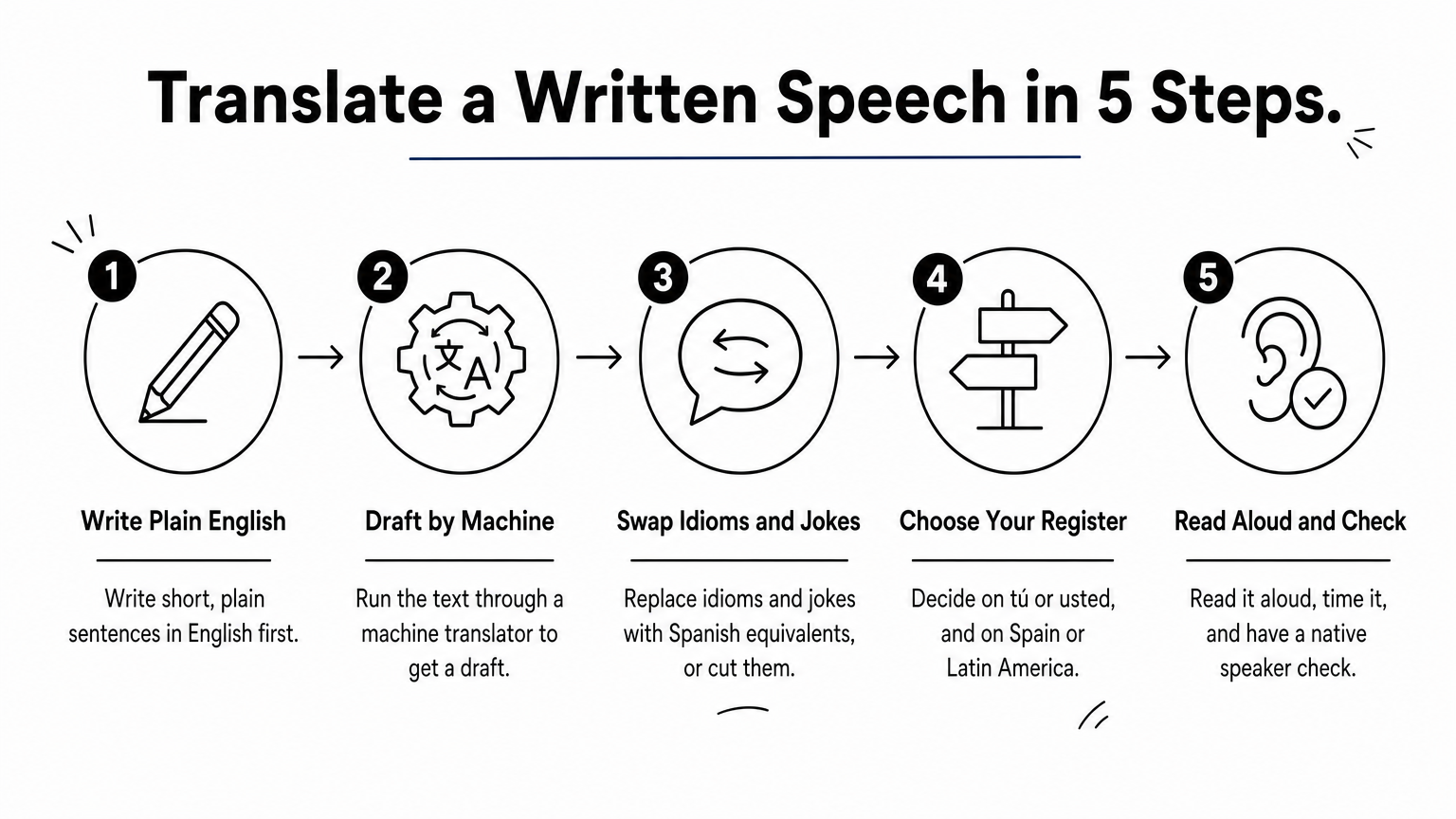
- Write short, plain sentences in English first. Long, idiom-heavy sentences translate badly.
- Run the text through a machine translator to get a draft.
- Replace idioms and jokes with Spanish equivalents, or cut them.
- Decide on tú or usted, and on Spain or Latin America, since vosotros is used mainly in Spain.
- Read it aloud, time it, and ask a native speaker to check it.
Treat the machine output as a draft, never as the final version. The review in the last step catches the errors that software misses, such as the wrong register.
Translating a spoken speech live
For a speech you hear in a meeting or webinar, you need live captions with translation. SidebySpeak runs as a Chrome or Edge extension and shows the original speech alongside its translation as captions on Google Meet, Zoom, Microsoft Teams and other browser calls. No bot joins the call, so nothing appears for other participants to approve. You can also turn on your own microphone, so your replies get captioned too.
A worked example shows the cost. The free plan gives you 20 minutes a month, which covers a 15-minute talk with time left over. If you sit in a weekly one-hour meeting, you use roughly four to five hours a month, which fits well within Basic.
| Plan | Price | Live minutes per month |
|---|---|---|
| Free | $0 | 20 |
| Basic | $9.99 per month | 600 (10 hours) |
| Pro | $20 per month | 1,500 (25 hours) |
Usage counts per minute of live call, and tab plus microphone together count as one minute. If you are also learning Spanish, Learn mode highlights matching words between the speech and its translation as they appear, which helps you pick up discurso, habla and the phrases above from real conversation.
Machine translation gives you a draft of a written speech, but live captions are how you follow a spoken one.
Pick the word by meaning
Speech in Spanish comes down to meaning. Use discurso for a talk before an audience, el habla for the ability or manner of speaking, and oratoria for the skill of public speaking. Learn "dar un discurso" first, keep el habla masculine in the article, and treat fixed phrases like libertad de expresión as separate units.
If you need to follow a Spanish speech live instead of just looking up a word, you can start with 20 free minutes of live translation in SidebySpeak and see Spanish captions on your next browser call.